
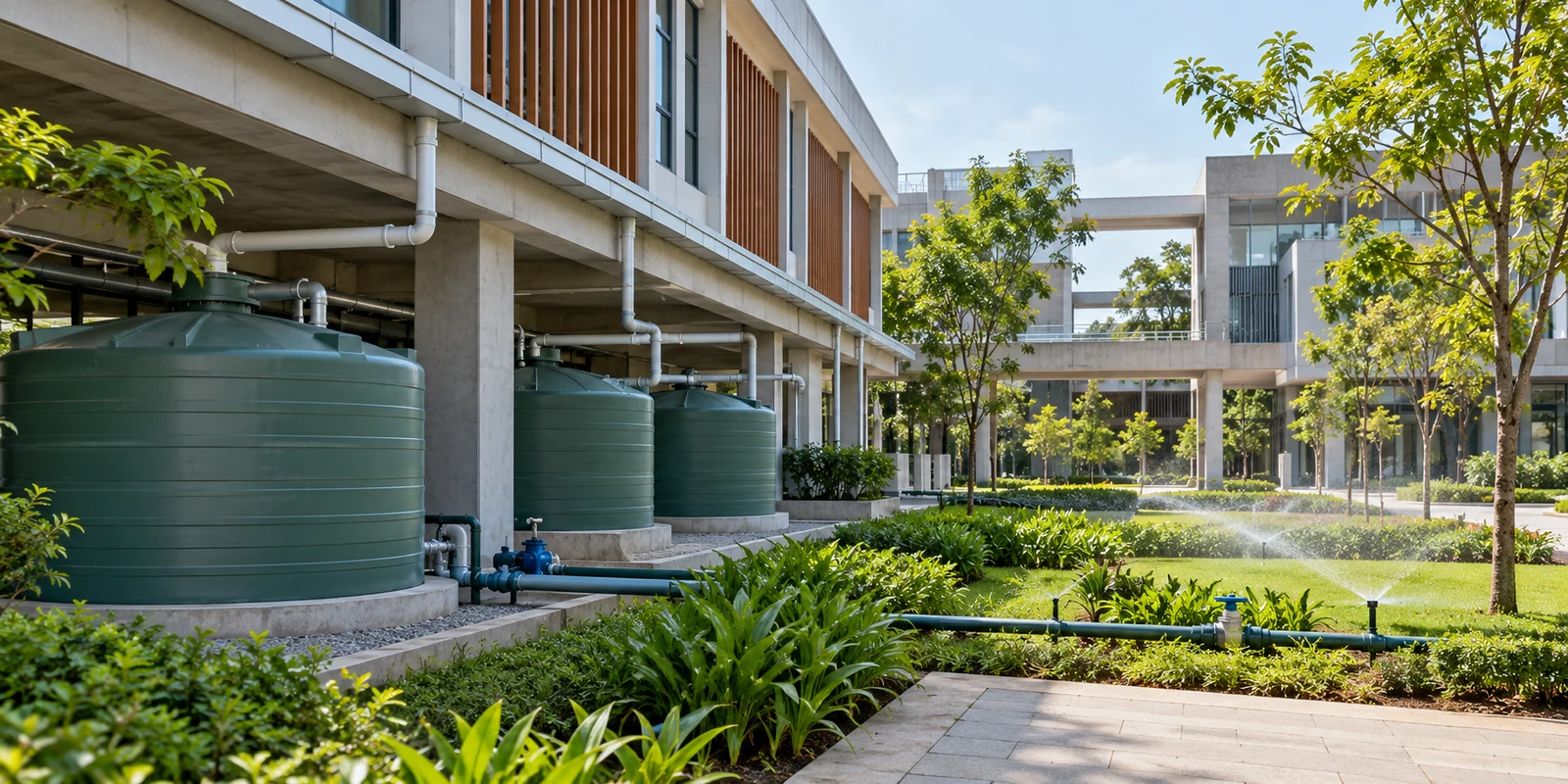
A rainwater tank should be sized to serve a defined use pattern—not chosen because a round capacity looks generous or because it fits the available corner of a site. A dependable estimate connects four things: the catchment, local rainfall, collection losses and the demand the stored water is intended to meet. The calculation is a planning input; final storage and structural design require site-specific engineering and local requirements.
“A x R x C,”
Central Ground Water Board
Start with the catchment, not the tank
Record the area that actually drains to the proposed system. For a roof, use the projected horizontal area and divide it where surfaces, materials or drainage routes differ. A building plan can help, but verify the dimensions and downpipes on site. Exclude surfaces with contamination risks until a qualified team decides whether they can be safely included and what pre-treatment would be required.
The Central Ground Water Board’s recharge manual expresses recharge potential as “A x R x C,” where the terms represent roof area, rainfall and runoff coefficient. In practical units, rainfall in millimetres multiplied by area in square metres gives litres before losses; apply an appropriate coefficient to reflect material and collection losses. CGWB’s manual lists different coefficients for roof materials, while other public guidance gives different values for some catchments. Use a value supported by the applicable method and the actual surface—not a universal default.
For illustration only, a 1,000-square-metre catchment receiving 800 millimetres of rainfall has a gross rainfall volume of 800,000 litres. If a design method uses a 0.8 coefficient for that surface, the preliminary yield is 640,000 litres before considering how rainfall is distributed, the first flush, gutter capacity, overflow and other site-specific losses. This is arithmetic, not a forecast or a recommended tank size. Replace the illustrative values with verified site data and the coefficient accepted by the project engineer.
Use local rainfall and a useful time step
An annual total hides important operating conditions. Two locations with the same annual rainfall can have different storm intensities, wet-season timing and dry intervals. Obtain rainfall records appropriate to the site and document the station, period and units. Where decisions depend on seasonal reliability, compare monthly or event-based rainfall rather than relying only on the annual average. IMD publishes rainfall information; a design team should verify the appropriate dataset, period and local relevance for the project.
Also check whether peak rainfall can reach the system faster than gutters, downpipes, filters or recharge structures can accept it. A yield estimate does not size a conveyance system or prove that a recharge structure can safely infiltrate that volume. Those are separate hydraulic and geotechnical design questions.
Build a demand profile before choosing capacity
List candidate uses individually: landscape irrigation, toilet flushing, cleaning, cooling make-up or another non-potable application. For each, estimate demand by month or operating shift, required water quality, hours of use, seasonal interruptions, location and the person responsible for the connection. Do not treat all non-potable uses as having the same quality requirements; determine safeguards with qualified professionals and applicable standards.
Compare supply and demand over time. A simple monthly balance begins with storage at the start of the month, adds estimated collected rainfall, subtracts planned use and records overflow or unmet demand. The sequence matters: water that arrives when the tank is full may overflow, while water collected months before use may require additional quality and turnover controls. Test a wet case, a typical case and a lower-rainfall case using a defensible dataset or design method. These scenarios help teams understand sensitivity; they are not a promise of future rainfall.
Distinguish yield from storage volume
Annual harvest potential and tank capacity are not the same number. A roof could produce a large theoretical volume over a year, while the actual tank needs to bridge only a certain period between rain events and user demand. Conversely, a tank smaller than the available runoff may overflow frequently if the demand is low or the wet season is concentrated. Size should follow the intended reliability objective, footprint, structural constraints, water quality and overflow route.
Check turnover and access as well as capacity. Slow-moving water can create additional inspection, cleaning and treatment considerations. Include a secure cover, screened openings where appropriate, a way to inspect and clean the tank, safe draw-off and a designed overflow. Keep harvested water separated from potable supplies unless a qualified design specifically provides the required treatment and safeguards.
A practical sizing sequence
1. Survey the catchment area, surface material, downpipes and drainage route. 2. Select local rainfall data and state the record period and design basis. 3. Apply a documented runoff coefficient and list excluded or uncertain losses. 4. Estimate monthly demand by use, quality requirement and operating owner. 5. Build a time-based storage balance that includes overflow and unmet demand. 6. Test lower-rainfall and demand-change scenarios; identify which assumptions matter most. 7. Check pump energy, structural capacity, maintenance access and safe overflow. 8. Have qualified professionals verify calculations, treatment and applicable approvals.
The calculation sheet should show inputs and units clearly so a future facilities team can update it when a roof, tenant, process or demand changes. Keep measured values distinct from assumptions. A precise-looking total built from unverified catchment dimensions or unsuitable rainfall records is not a reliable design basis.
Make the tank answer an operating question
Before procurement, ask what reliability the organisation expects: which users should be supplied, through what season, and what backup is acceptable? Name who checks levels, filters, pumps and overflow, and how faults are recorded. Where the system is intended for recharge rather than direct use, involve hydrogeological expertise and assess source-water quality and site conditions. Storage is only one part of a rainwater system; catchment, conveyance, treatment, use, overflow and maintenance all affect performance.
Key takeaways
- Estimate catchment yield with locally supported assumptions and realistic losses.
- Model rainfall and demand using a useful time step rather than annual totals alone.
- Separate rainwater yield, tank volume and dependable usable supply.
- Choose storage to solve a stated operating need and verify the model against measured performance.
Related SWR guides and services
Sources and further reading
Calculation examples are illustrative planning calculations, not reported project results. Confirm current Indian and site-specific requirements before applying international guidance.