
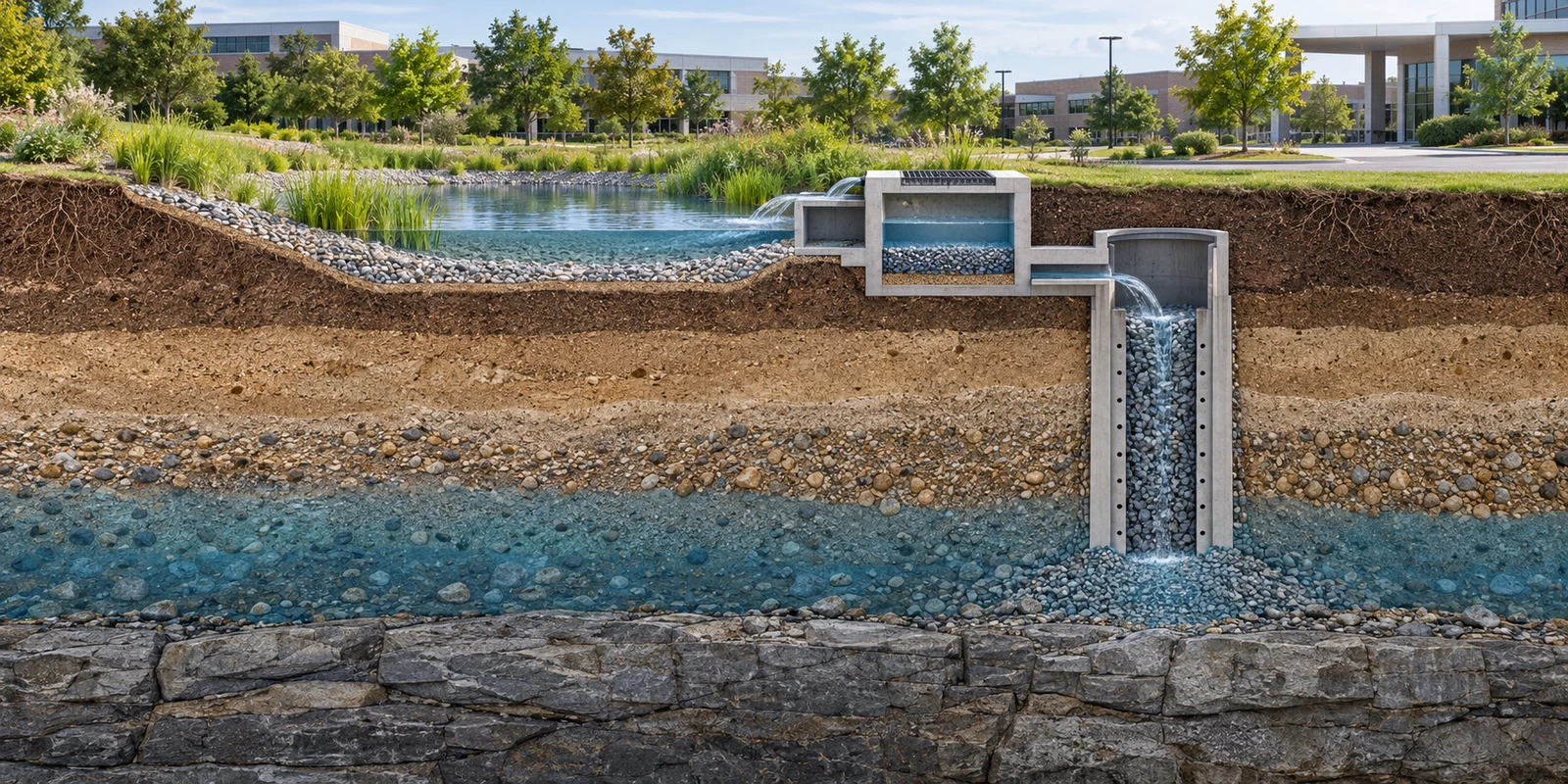
A rainwater-recharge proposal can look simple on a site plan: connect a catchment to a pit, trench or well. Yet the structure is only one link in a longer chain. The catchment must yield water of acceptable quality, conveyance must handle real storm flows, the ground must be appropriate for the method, and someone must inspect and maintain the system. A short, disciplined investigation before design helps avoid sizing a structure around assumptions that the site cannot support. The Central Ground Water Board’s manual on artificial recharge covers investigations for site selection, source-water considerations, planning, design, monitoring, impact assessment and operation and maintenance. CGWB describes it as a “guide and reference” for professionals implementing recharge schemes. That breadth is a useful reminder: recharge is a hydrogeological intervention, not simply a civil-work item.
“guide and reference”
Central Ground Water Board
First establish the project boundary
Map the catchment and receiving area separately. Which roofs or paved surfaces are included? Which are excluded because of dust, vehicle activity, process exposure or other contamination risks? Where does each drain go today? What flow path is available during an extreme storm if the proposed structure is full or blocked?
Walk the site with operations and maintenance staff, not only the design team. They can point out recurring ponding, drains that back up, areas affected by vehicle movement and access routes needed for cleaning. Survey levels and visible connections, and check available records for underground utilities and previous construction. Do not assume that the site drawing reflects today’s layout.
Characterise the source water
Rainwater quality is influenced by the collection surface, accumulated debris, atmospheric deposition and maintenance condition. Inspect roof materials and drainage channels. Decide what debris screens, first-flush diversion and filtration are appropriate, and whether sampling is needed to understand the source. The correct sampling plan depends on the proposed use and the local source conditions; a generic one-time test should not be treated as a permanent quality guarantee.
If water may be routed to recharge, consider whether site activities could introduce oils, chemicals or solids. Define a response for spills and maintenance events that could contaminate the catchment. A diversion or isolation arrangement can be important where the quality of runoff is not always predictable.
Understand the subsurface and constraints
Recharge method selection depends on subsurface conditions, depth to groundwater, soil and rock characteristics, local groundwater context, water quality and site constraints. Use qualified hydrogeological input where the proposed scheme requires it. Existing wells, nearby structures, contamination sources, seasonal waterlogging and flood conditions may all affect what is appropriate. A convenient location is not necessarily a safe or effective recharge location.
Compile available bore logs, groundwater-level information, geology and prior investigations, but identify their age, location and limits. Where records are insufficient for a design decision, plan suitable field investigations rather than quietly substituting a regional average. Confirm setback and approval requirements with relevant local authorities and technical professionals.
Check the whole hydraulic route
The design brief should include the catchment area and material, rainfall data and assumptions, drainage layout, conveyance capacity, debris and first-flush arrangements, filtration, storage or diversion, recharge component and overflow. Consider sediment accumulation and how each stage can be cleaned. Ask whether operators can isolate a unit safely and whether maintenance access remains available after landscaping or parking changes.
Model more than one rainfall scenario. Annual rainfall totals do not show whether the system can manage intense short-duration storms, long dry gaps or a storage tank that is already full. Clearly identify assumptions and the consequence if the real conditions differ. An explicit uncertainty is easier to manage than a precise-looking design based on weak inputs.
Create decision gates before construction
Before design freeze, document the purpose, evidence sources, exclusions, quality controls, maintenance plan and unresolved investigations. Before procurement, confirm that civil and plumbing drawings agree and that the overflow route is accepted. During construction, inspect hidden works before they are covered. At commissioning, test flow paths and safety arrangements and record the as-built system. After rainfall events, inspect performance and record maintenance, water levels and faults.
Monitoring should match the objective. If the purpose is recharge, select indicators with the responsible technical team—such as rainfall, inflow, system condition and groundwater observations at appropriate locations and intervals. Do not equate the volume diverted into a structure with a proven increase in usable groundwater; that requires suitable evidence and interpretation.
A concise pre-design evidence pack
1. Site plan with catchments, drains, levels, utilities and overflow paths. 2. Rainfall source, period, location and design assumptions. 3. Surface condition and source-water risk assessment. 4. Available geology, groundwater and site-investigation records. 5. Proposed use/recharge objective, method options and constraints. 6. Maintenance access, inspection frequency, monitoring and ownership.
November is a practical time to assemble this evidence after observing the current wet season and before design and procurement intensify. The timing gives a project team room to investigate, but site-specific technical review remains essential. The right first deliverable is often not a tank size; it is a defensible design brief that makes clear what is known, what is uncertain and what must be checked before construction.
Match the investigation to the decision
Not every site needs the same level of testing. Start by listing the decisions that depend on evidence: whether recharge is appropriate at all, which catchment can contribute, what pre-treatment is needed, where the structure can be placed, and how performance will be monitored. Then identify the minimum reliable information needed to make each decision. Existing reports may answer some questions, while others may require a qualified field investigation. This avoids both under-investigation and collecting data that does not change the design.
Where groundwater is a sensitive or regulated resource, include the relevant authority and technical specialists early. Confirm current local requirements rather than assuming one national checklist covers every project. Record the version and date of drawings and datasets; groundwater levels, site layouts and land use can change. If a recharge proposal cannot be supported by adequate evidence, consider whether controlled storage, non-potable use or a different stormwater approach better fits the site.
Key takeaways
- Define project boundaries, objectives and the receiving formation.
- Characterise the source water and keep contaminated catchments separate.
- Use site-specific soil, geology, groundwater and infiltration evidence.
- Document decision gates, hydraulic routes, approvals and maintenance before construction.
Related SWR guides and services
Sources and further reading
Calculation examples are illustrative planning calculations, not reported project results. Confirm current Indian and site-specific requirements before applying international guidance.